How To Use "radio" Input Fields
Q
How To Use "radio" Input Fields? - XHTML 1.0 Tutorials - Understanding Forms and Input Fields
✍: FYIcenter.com
A
A "radio" input field is defined as <input type="radio" .../>. "radio" input fields can be used to create a group of radio buttons to allow viewers to push one and only one button in the group. There are other attributes you may need to use for a "radio" input field:
- name="fieldName" - Specifies the name of this field. To define a group of radio buttons, you need to use the same field name for all the buttons in the group.
- value="selectedValue" - Specifies the value to be used when this radio button is pushed. The default is value="on".
- checked="checked" - Specifies that this checkbox is pushed by default.
Here is a tutorial example with three radio button input fields:
<?xml version="1.0" ?>
<!DOCTYPE html PUBLIC "-//W3C//DTD XHTML 1.0 Strict//EN"
  "http://www.w3.org/TR/xhtml1/DTD/xhtml1-strict.dtd">
<html>
 <head>
  <title>Radio Button Input Fields</title>
 </head>
 <body>
  <h4>Online Survey</h4>
  <form action="http://localhost/submit">
  <p style="background-color: #eeeeee; padding: 8px;">
   How did you find FYIcenter:<br/>
        <input type="radio" name="channel"
     value="google" checked="checked"/>Google search<br/>
        <input type="radio" name="channel"
     value="yahoo"/>Yahoo search<br/>
        <input type="radio" name="channel"
     value="friend"/>Your friend<br/>
   <input type="submit" value="Submit"/>
  </p>
  </form>
 </body>
</html>
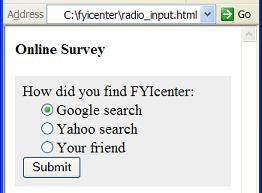
If you save the above document as radio_button_input.html, and view it with
Internet Explorer, you will see a form with three radio button input fields as shown below:
2007-05-12, 5636👍, 0💬
Related Topics: